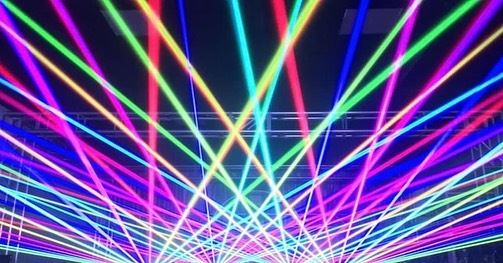
A laser show can look like magic: solid beams of color slicing through the air, tunnels of light, waves rolling over a crowd. But it’s built from a few simple ideas. Here’s how laser light shows work, explained without the jargon.
Where the light comes from
A show laser projector combines red, green and blue lasers. By mixing those three colors at different strengths, the projector can create almost any color, from deep red to gold to white. That’s how a holiday show can move from Christmas red and green to warm gold in a single song.
How the beam moves
Inside the projector, the laser beam bounces off two tiny mirrors mounted on very fast motors called galvanometers, or “galvos.” One mirror moves the beam left and right and the other moves it up and down. The galvos can reposition the beam thousands of times per second.
When the beam moves slowly or stops, you see a single solid beam. When it moves fast enough, your eye blends the motion together, and you see shapes: a fan of beams, a sheet of light, a cone or a tunnel. This is the same reason a sparkler drawn in a circle looks like a ring.
Why haze makes or breaks the show
A laser beam is invisible as it travels through clean air. You only see where it lands. To see the beam itself, there has to be something in the air for the light to bounce off. That’s what haze does.
Haze machines release a fine, light mist that hangs in the air and catches the light, so the beams become visible along their whole length. Without haze, a “beam show” turns into a few dots on a wall.
Outdoors, natural humidity helps, and South Florida has plenty, but wind is the enemy. A steady breeze can carry haze away faster than machines can make it. That’s why outdoor shows place haze machines upwind and why wind is part of every show-day weather check. Our South Florida holiday weather guide goes into this.
Beam shows vs. graphics shows
- Beam shows project light through the air above the audience. This is the classic concert and festival look, and it needs haze and darkness.
- Graphics shows draw images, text and animations onto a surface such as a building, a screen, a stage backdrop, trees or a water screen. They don’t need haze, but they need a good surface to project on.
Many holiday shows mix both: beams for energy and graphics for things like snowflakes, a countdown or a message.
Syncing to music
A professional laser show is programmed ahead of time on show-control software, cue by cue, to a specific piece of music. During the show, the software plays the laser cues in sync with the audio, often locked together with timecode so the beams hit on the beat every time. Live operators can also trigger effects in real time, which is how lasers work on a DJ’s dance floor.
Lighting, effects and the rest of the show
Lasers are rarely the only thing in a show. Our first Electric Holiday season combined lasers with strobes, intense moving lights, fog, cryo effects and snow; read about it in our 2020 recap. Moving lights add big washes of color and movement, strobes add punch, and effects like snow add atmosphere for a holiday crowd.
Where projectors go
Projector placement decides what the audience sees. Projectors are usually set in front of or beside the audience, aimed so beams pass well above head height. For a tree lighting, they might frame the tree. For a drive-in, they usually sit in front of the first row. They’re always in a secured area with an operator nearby.
Safety is built in
Because show lasers are powerful, professional shows follow federal rules and safety practices, including keeping beams away from audience eyes and coordinating with the FAA for outdoor shows. Our outdoor laser show rules guide explains what organizers should know.
See it in person
Want to see how it all comes together? Check out the Electric Holiday show, browse our event ideas, or tell us about your event.