Lasers vs. Fireworks vs. Drone Shows: Choosing the Right Holiday Spectacle

LASER LIGHT SHOW

Every big holiday event wants a “wow” moment. The three most common choices are fireworks, laser light shows and drone light shows. Each has real strengths and real trade-offs. Here’s an honest comparison of lasers vs. fireworks vs. drones to help you choose what fits your event, your venue and your budget.

Fireworks

Strengths

  • The classic celebration everyone recognizes
  • Huge scale, visible from far away
  • The sound and the boom are part of the experience

Trade-offs

  • Permits and fire safety. Fireworks need licensed operators, fire marshal approval and large safety zones where the public can’t be.
  • Weather. High wind can cancel a display, and dry conditions can lead to restrictions.
  • Noise. Loud for neighbors, pets, wildlife and people sensitive to explosions.
  • Debris and smoke. Cleanup is needed, and smoke can drift over the crowd.
  • Short and single-use. Most displays last minutes, and every shell is used once.

Drone light shows

Strengths

  • Can draw recognizable shapes, logos and animations in the sky
  • Quiet compared with fireworks
  • Very shareable on social media

Trade-offs

  • Cost scales with drones. More detail needs more drones, and large shows can be expensive.
  • FAA approvals. Drone shows require specific FAA authorizations and are limited near airports and other controlled airspace.
  • Wind and rain. Drones have weather limits and shows can be delayed or canceled.
  • Short duration. Battery life limits a show to a short window.

Laser light shows

Strengths

  • Flexible length. A show can be a 5-minute moment or run on and off all night, including on a dance floor.
  • Works in more places. Lasers can run outdoors, near homes and indoors, where fireworks usually can’t.
  • Repeatable. The same show can run several times a night or every weekend of the season.
  • Music sync. Beams are timed precisely to the music, which makes the show feel like a performance.
  • Little noise or debris beyond the music you choose to play.

Trade-offs

  • Needs darkness and haze. Beams are only visible when it’s dark and there’s haze in the air. Strong wind can thin the effect. See our explainer on how laser light shows work.
  • Regulated. Professional lasers need an FDA variance, and outdoor shows require FAA notification. See our outdoor laser show rules guide.
  • Viewing area. Lasers look best from a defined audience area rather than from miles away.

Side-by-side

  • Best for a single big moment visible across town: fireworks
  • Best for logos and shapes in the sky: drones
  • Best for a show that runs several times, works indoors, or keeps a party going: lasers
  • Quietest: drones and lasers
  • Least affected by burn restrictions: drones and lasers

Combining them

Many large events combine options: a laser show throughout the night with fireworks at the finale, or lasers on the ground with drones in the sky. If budget allows, combining them gives you the long-running energy of lasers and the big finish of fireworks.

Which is right for you?

Start with your venue and your audience. A downtown celebration with a riverfront might choose fireworks. A shopping center that wants weekly shows all December, an HOA next to homes, or an indoor corporate party is usually a better fit for lasers. Our posts on New Year’s Eve laser shows and shopping center shows show how lasers fit those settings.

Questions? Tell us about your event, or see the Electric Holiday show.
12 Questions to Ask Before You Hire a Laser Show Company

BACKGROUND LASER LIGHT

Not all laser shows are created equal. Two quotes for a “laser light show” can describe very different things, from a single small projector to a full production with sound, lighting and a trained crew. These questions to ask a laser show company will help you compare vendors fairly and avoid surprises on event night.

Safety and compliance

1. Do you hold a current FDA laser light show variance?

Professional shows using high-powered lasers generally need a variance from the FDA. Ask whether the company holds one and whether it covers the equipment and type of show they’re proposing. Our outdoor laser show rules guide explains why this matters.

2. Will you file the FAA notice for an outdoor show, and when?

Outdoor shows projected into the sky require advance notice to the FAA, with at least 30 days recommended. A professional company handles this as part of the job.

3. Can you provide a certificate of insurance?

Most venues, cities and parks require one. Ask early so there’s time to add the venue as additional insured if needed.

4. Who operates the show, and what’s their experience?

Every show should have a trained operator on site with an emergency stop. Ask who that person will be.

The show itself

5. What exactly is included?

How many projectors, and how powerful? Are haze machines included? What about sound, stage lighting, a DJ or MC, video screens and staging? Get the list in writing so you can compare quotes properly.

6. How long is the show, and can it run more than once?

Some events want a single 10-minute moment. Others want shows every hour. Ask how pricing changes with length and repeats.

7. Is the show custom-programmed or pre-built?

Pre-built shows can be excellent and affordable. Custom programming to your music, colors or tree lighting costs more but feels made for your event. Ask what’s possible within your budget. Our explainer on how laser light shows work covers how shows are programmed.

8. Can we see video of a past show?

Video tells you more than any description. Ask for footage from an event similar to yours, outdoor or indoor, at a similar size.

Logistics

9. Will you do a site visit?

A good vendor wants to see the venue, ideally after dark, to check power, sightlines, projector placement and nearby light sources.

10. What do you need from us on site?

Power, space for equipment, a secured area, load-in access, parking for trucks and setup time. Knowing this early prevents last-minute problems.

11. What’s your weather plan?

What happens with wind, rain or lightning? Who makes the call, and when? Is there a fee to move to a backup date? Our South Florida holiday weather guide explains the risks.

The contract

12. What are the deposit, payment and cancellation terms?

Ask about the deposit, when the balance is due, and what happens if the event is canceled by you, by weather, or by a permit decision. Get it in writing.

A quick comparison checklist

  • FDA variance confirmed
  • FAA notice included for outdoor shows
  • Insurance certificate available
  • Equipment list in writing
  • Sound, lighting and DJ included or separate
  • Site visit scheduled
  • Weather and cancellation policy in writing
  • Video of past shows reviewed

Ask us anything

We’re happy to answer every question on this list. Tell us about your event, read about our 2020 season, or see the Electric Holiday show.
South Florida Holiday Event Weather: Planning Around Wind, Rain and Sunset

ELECTRIC HOLIDAY BACKGROUND

One of the best things about holiday events in South Florida is the weather. December falls in the dry season, nights are usually mild, and outdoor events are possible when much of the country is snowed in. But “usually” isn’t a plan. Here’s how South Florida holiday weather affects outdoor events and laser shows, and how to prepare.

What December is typically like in Miami-Dade

  • Temperatures: Typical December days are in the mid to upper 70s °F, with evenings in the 60s. Cold fronts can occasionally bring evenings down into the 50s.
  • Rain: December is one of the drier months, but passing showers still happen, especially ahead of a cold front.
  • Humidity: Lower than summer, but still enough to help laser beams show up in the air.
  • Hurricane season officially ends November 30, so it’s rarely a factor for December events.

Always check the official forecast from the National Weather Service Miami office in the days before your event.

Sunset and show times

In Miami, the sun sets around 5:30 p.m. in early to mid December, the earliest sunsets of the year, and about 5:40 p.m. by late December. It takes roughly half an hour more for the sky to get fully dark. Lasers look best in true darkness, so:

  • Plan the first laser show no earlier than about 6:15–6:30 p.m.
  • Use the dusk period for arrivals, food, music and stage performances
  • Do laser checks after dark on show day, not in the afternoon

Wind: the biggest factor for laser shows

For a laser show, wind matters more than almost anything else. Beams are only visible when there’s haze in the air, and wind blows the haze away. A light breeze is manageable, but steady, strong wind can thin the beams dramatically. Our explainer on how laser light shows work explains why.

Ways to plan for wind:

  • Place haze machines upwind of the audience
  • Choose a site with some natural wind protection if possible
  • Design part of the show around graphics projected on a surface, which don’t depend on haze
  • Secure tents, banners and signs, since cold fronts can bring gusts

Rain

Professional show equipment can be protected from light rain, and drive-in events handle drizzle well because guests are in their cars. Heavy rain, though, is hard on guests and equipment, and lightning is a firm stop. A solid weather plan includes:

  • A decision time, such as noon on event day, to go ahead, delay or move to a backup date
  • A backup date reserved with the venue and vendors in advance
  • A lightning policy: pause outdoor activities when lightning is nearby and wait for it to pass
  • Clear communication: know how you’ll notify guests by social media, email or text

Cold front nights

When a cold front comes through, South Florida evenings can feel surprisingly chilly to locals. Remind guests to bring a sweater, consider hot cocoa or coffee vendors, and keep drive-in guests comfortable in their cars.

Before you sign contracts

Ask every vendor about their weather policy. How are rain delays handled? Is there a fee to move to a backup date? Who makes the final call? Our list of questions to ask a laser show company includes these.

Planning a holiday event?

Use our month-by-month planning timeline, browse event ideas, or tell us about your event.

Drive-In Event Audio: How FM Radio Broadcasting Works for Light Shows

BACKDROP ELECTRIC HOLIDAY

At a drive-in event, every car becomes its own speaker. Guests tune their radio to a station, and the music and announcements play through their own sound system. It’s one of the reasons drive-in light shows feel so immersive. Here’s how FM radio audio for drive-in events works, and what organizers should plan for.

The basic setup

The show’s audio, meaning the music, the host’s announcements and any pre-show content, is fed from the sound board into a small FM transmitter connected to an antenna. The transmitter broadcasts on a single FM frequency, and any car radio in range can pick it up, just like a regular station.

What the FCC allows

In the United States, FM radio is regulated by the Federal Communications Commission. Under the FCC’s Part 15 rules, very low-power FM transmitters can be used without a broadcast license, but only within strict limits on signal strength. In practice, that keeps a legal unlicensed transmitter’s range short, often only a couple of hundred feet depending on the antenna, terrain and interference.

That’s why the transmitter and antenna placement matter so much, and why a large lot may need more than one transmitter spread across the parking area. Overpowered transmitters can interfere with licensed stations and are illegal, so work with a production team that knows the rules. You can read the FCC’s own overview of low-power radio.

Choosing a frequency

South Florida’s FM dial is crowded. Before the event, the production team scans for a frequency that’s clear at your specific site, with no strong local station on it or right next to it. The check should be done at the site itself, because a frequency that’s clear in Homestead may not be clear in Miami.

Testing the coverage

On setup day, the crew should drive or walk the entire lot with a radio, especially the back rows and corners, to make sure the signal is clean everywhere cars will park. Weak spots can often be fixed by moving or raising the antenna.

Tips to share with guests

  • Post the frequency everywhere: on tickets, on the event page and on a big sign at the entrance.
  • Tune in before you park, so staff can help if a car has trouble.
  • Use accessory mode and turn the engine off if the event allows it, but watch the battery.
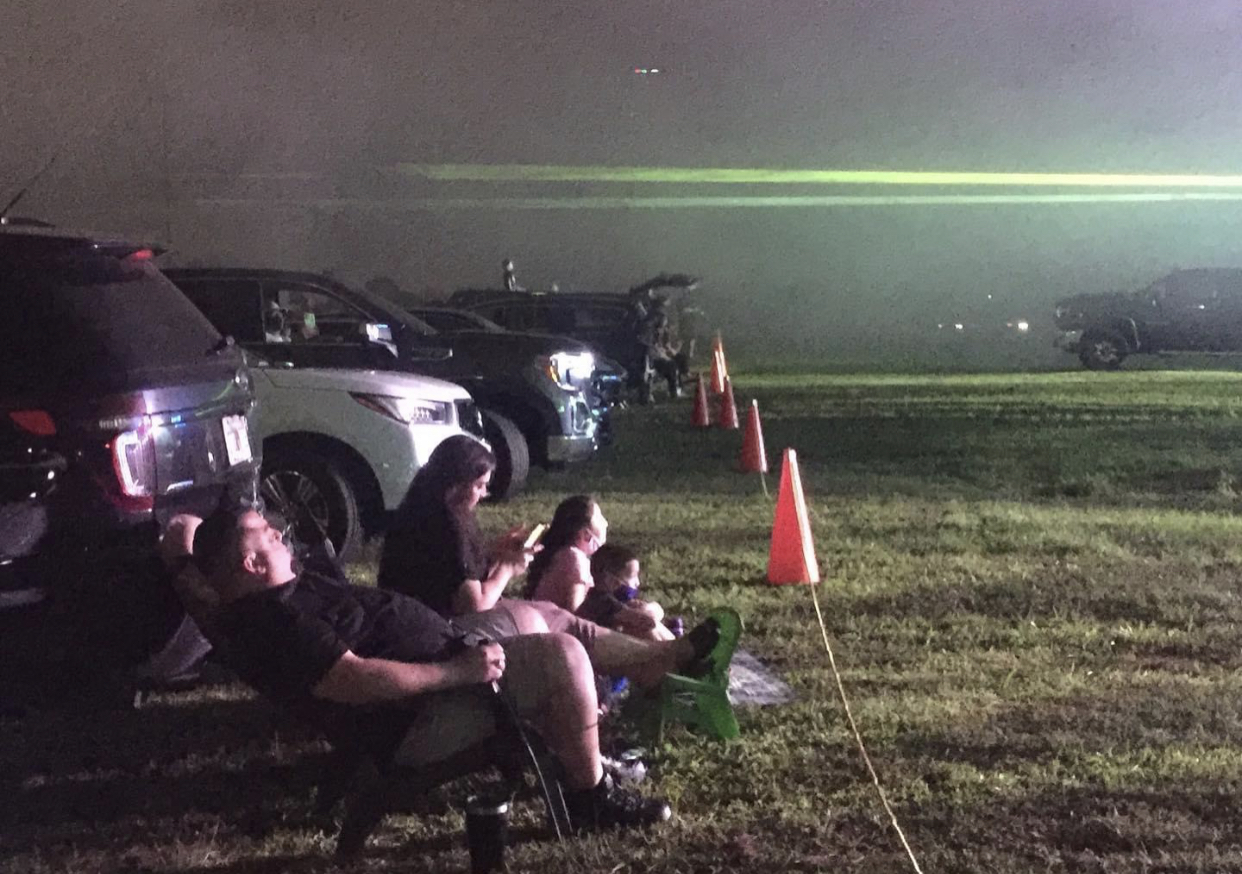
  • Turn off headlights and avoid using brake lights during the show. Bright car lights wash out the lasers for everyone.
  • Bring a portable radio if your car radio isn’t working.

Plan for dead batteries

A car radio playing for an hour with the engine off can drain an older battery. Keep jump-start packs on site and assign a staff member to handle them, especially at the end of the night when everyone tries to leave at once.

Alternatives and backups

  • Loudspeakers pointed at the lot can work for small events, but they are louder for neighbors and less clear in the back rows.
  • Phone streaming lets guests listen through an app or web stream. It’s a useful backup, but streams have a delay, so the music can drift out of sync with the lasers.
  • A portable radio at the info booth for guests who need one.

Syncing the show

Because the radio broadcast is nearly instant, the lasers and lights can be programmed to the same audio feed that goes to the transmitter. That keeps every beam on the beat for every car. Our explainer on how laser light shows work covers how shows are synced to music.

Using the radio for more than music

At our 2020 Homestead-Miami Speedway show, the FM station carried arrival instructions and a 30-minute pre-show with crowd participation games before the main show. The radio is a great way to welcome guests, thank sponsors and share safety messages. Read the full story in our Electric Holiday 2020 recap.

Planning a drive-in show?

See our guide to drive-in holiday laser light shows, or tell us about your site and we’ll plan the audio and the show together.

How Laser Light Shows Work: Projectors, Haze and Beam Effects Explained

ELECTRIC HOLIDAY 2020

A laser show can look like magic: solid beams of color slicing through the air, tunnels of light, waves rolling over a crowd. But it’s built from a few simple ideas. Here’s how laser light shows work, explained without the jargon.

Where the light comes from

A show laser projector combines red, green and blue lasers. By mixing those three colors at different strengths, the projector can create almost any color, from deep red to gold to white. That’s how a holiday show can move from Christmas red and green to warm gold in a single song.

How the beam moves

Inside the projector, the laser beam bounces off two tiny mirrors mounted on very fast motors called galvanometers, or “galvos.” One mirror moves the beam left and right and the other moves it up and down. The galvos can reposition the beam thousands of times per second.

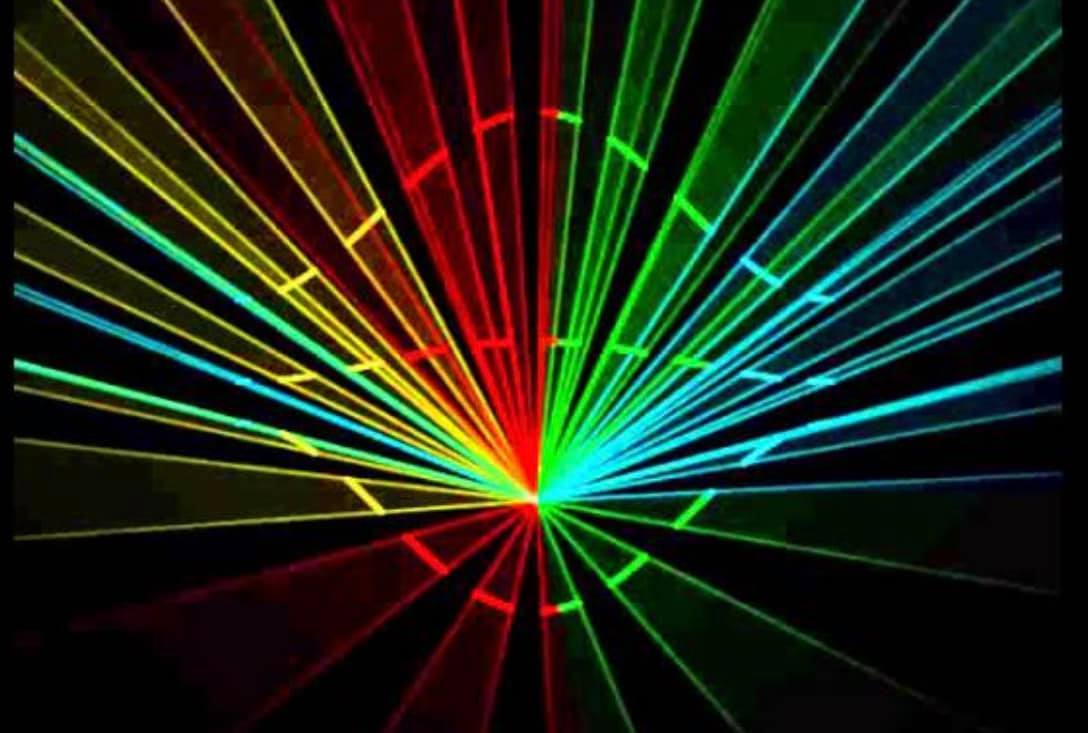
When the beam moves slowly or stops, you see a single solid beam. When it moves fast enough, your eye blends the motion together, and you see shapes: a fan of beams, a sheet of light, a cone or a tunnel. This is the same reason a sparkler drawn in a circle looks like a ring.

Why haze makes or breaks the show

A laser beam is invisible as it travels through clean air. You only see where it lands. To see the beam itself, there has to be something in the air for the light to bounce off. That’s what haze does.

Haze machines release a fine, light mist that hangs in the air and catches the light, so the beams become visible along their whole length. Without haze, a “beam show” turns into a few dots on a wall.

Outdoors, natural humidity helps, and South Florida has plenty, but wind is the enemy. A steady breeze can carry haze away faster than machines can make it. That’s why outdoor shows place haze machines upwind and why wind is part of every show-day weather check. Our South Florida holiday weather guide goes into this.

Beam shows vs. graphics shows

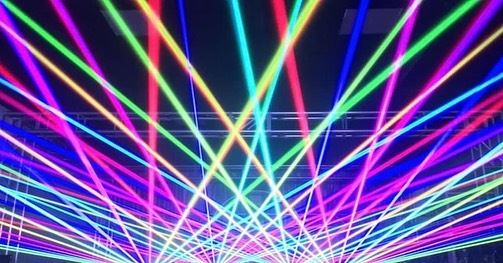
  • Beam shows project light through the air above the audience. This is the classic concert and festival look, and it needs haze and darkness.
  • Graphics shows draw images, text and animations onto a surface such as a building, a screen, a stage backdrop, trees or a water screen. They don’t need haze, but they need a good surface to project on.

Many holiday shows mix both: beams for energy and graphics for things like snowflakes, a countdown or a message.

Syncing to music

A professional laser show is programmed ahead of time on show-control software, cue by cue, to a specific piece of music. During the show, the software plays the laser cues in sync with the audio, often locked together with timecode so the beams hit on the beat every time. Live operators can also trigger effects in real time, which is how lasers work on a DJ’s dance floor.

Lighting, effects and the rest of the show

Lasers are rarely the only thing in a show. Our first Electric Holiday season combined lasers with strobes, intense moving lights, fog, cryo effects and snow; read about it in our 2020 recap. Moving lights add big washes of color and movement, strobes add punch, and effects like snow add atmosphere for a holiday crowd.

Where projectors go

Projector placement decides what the audience sees. Projectors are usually set in front of or beside the audience, aimed so beams pass well above head height. For a tree lighting, they might frame the tree. For a drive-in, they usually sit in front of the first row. They’re always in a secured area with an operator nearby.

Safety is built in

Because show lasers are powerful, professional shows follow federal rules and safety practices, including keeping beams away from audience eyes and coordinating with the FAA for outdoor shows. Our outdoor laser show rules guide explains what organizers should know.

See it in person

Want to see how it all comes together? Check out the Electric Holiday show, browse our event ideas, or tell us about your event.

Outdoor Laser Show Rules: FAA and FDA Basics for Event Organizers

If you’re planning an event with a laser show, you don’t need to become a laser safety expert, but you should understand the basics well enough to ask your vendor the right questions. This guide explains the main federal rules for outdoor laser shows in the United States in plain language.

This article is general information, not legal advice. Rules change, so always confirm current requirements with the agencies involved and your local officials.

Why lasers are regulated

Show lasers are powerful. The same brightness that makes a beam visible across a stadium can injure eyes if a beam hits someone directly, and can dazzle a pilot if it’s aimed into the path of an aircraft. Two federal agencies handle these two risks:

  • The FDA regulates laser products and laser light shows to protect audiences and the public.
  • The FAA protects aircraft and airspace when lasers are projected outdoors.

The FDA and laser show variances

The FDA’s Center for Devices and Radiological Health sets performance standards for laser products. The high-powered lasers used in most professional shows, Class IIIb and Class IV, generally can’t be used for entertainment unless the manufacturer or show producer holds an approved variance from the FDA. A variance is permission to use these lasers under specific safety conditions.

Variance conditions typically cover how the show is set up and operated, including keeping beams a safe distance above and away from the audience unless audience scanning has been specifically evaluated and approved, using an operator who can stop the show immediately, and keeping records of each show.

What to ask your vendor: “Do you hold a current FDA laser light show variance, and does it cover the equipment and type of show you’re proposing?”

The FAA and outdoor laser operations

When beams go into the sky, they enter airspace. The FAA asks laser operators to submit a notice of proposed outdoor laser operations, commonly on FAA Form 7140-1, in advance of the event. FAA guidance recommends filing at least 30 days ahead. The FAA reviews the location, the direction and power of the beams, and nearby flight paths, and then responds, usually with a letter of non-objection or with conditions or concerns.

Locations near airports get closer review. South Florida has a lot of air traffic, with major and regional airports, military airfields and helicopter routes, so expect the FAA to look carefully at shows across Miami-Dade. Conditions can include limits on beam direction, beam power or show times, or a requirement for spotters who can stop the show if an aircraft approaches.

What to ask your vendor: “Will you file the FAA notice for our show, and when will you file it?”

State and local rules

On top of federal rules, states and local governments can have their own requirements. Florida has state rules for certain classes of lasers, and your city or county may require a special event permit, fire marshal review, a noise permit or proof of insurance. Your special events office is the best place to start.

Indoor shows

Indoor shows don’t need FAA notification, because beams don’t reach the sky, but the FDA rules for audience safety still apply. Indoors you’ll also need to coordinate with the venue about haze and smoke detectors.

Safety practices you should expect

  • A trained operator present for the whole show with an emergency stop
  • Projectors in a secured area the public can’t reach
  • Beams kept above head height and away from where people stand, unless an approved audience-scanning plan is in place
  • Beams terminated on safe surfaces or directed into open sky as approved, not into windows or reflective buildings
  • A plan to pause the show if aircraft approach or conditions change

Timeline tip

Because the FAA recommends at least 30 days of notice, and local permits can take longer, laser paperwork should be part of your plan two to three months before the event. Our holiday event planning timeline shows where this fits.

Where to learn more

Planning a show? Read our list of questions to ask a laser show company, or tell us about your event and see the Electric Holiday show.

How to Plan a Holiday Event in Miami-Dade: A Month-by-Month Timeline

Holiday events look effortless when they go well, but the best ones start months before the first guest arrives. Whether you’re planning a city tree lighting, a school winter festival or a company party, this holiday event planning timeline for Miami-Dade breaks the work into manageable steps.

The timeline assumes an event in early to mid December. If your event is later, shift each step back.

5–6 months out (June–July): set the foundation

  • Define the goal. Is this a community celebration, a fundraiser, a customer event or a thank-you for employees? The goal shapes every other decision.
  • Pick a date and a backup date. December weekends fill fast across South Florida. A rain date is a good idea for any outdoor event.
  • Estimate attendance. A rough number is enough for now. It drives venue size, parking, staffing and budget.
  • Choose and hold the venue. Parks, fields and popular venues book early for December.
  • Set a working budget. Include production, permits, staffing, rentals, marketing and a contingency of around 10%.

4 months out (August): book the big pieces

  • Book your main entertainment and production. Laser shows, sound, lighting, staging and DJs are in high demand in December. Our list of questions to ask a laser show company helps you compare vendors.
  • Schedule a site visit. Walk the venue with your production team after dark if you can. Look for power, lighting, sightlines and how crowds will move.
  • Start sponsor outreach. Businesses plan their holiday budgets early.

3 months out (September): permits and plans

  • Contact your city or county special events office. Ask what permits apply: special event, park use, noise, road closures, vendors or tents.
  • Start laser notifications. Outdoor laser shows projected into the sky require advance notice to the FAA. See our outdoor laser show rules guide. Your laser provider should handle this, but confirm it’s on their calendar.
  • Draft a site plan. Mark the audience area, stage, equipment zone, vendors, restrooms, first aid, entrances and emergency access.
  • Arrange insurance. Venues and cities often require a certificate naming them as additional insured.

2 months out (October): lock the details

  • Finalize the run of show with times for each segment
  • Confirm food vendors, rentals such as tents, chairs, barricades and portable restrooms, and security
  • Recruit volunteers or staff, and assign roles
  • Choose music for key moments like a countdown or tree lighting
  • Design your event graphics

6 weeks out (late October to early November): promote

  • Publish an event page with the date, time, location, parking, accessibility and any ticket or donation details
  • Post on social media and send email announcements
  • Send the event to local news and community calendars
  • Ask sponsors and partners to share it

2 weeks out: final confirmations

  • Confirm arrival times with every vendor
  • Share the final site plan and run of show with your team
  • Check the long-range forecast and review your weather plan
  • Prepare signs: parking, entrances, restrooms and, for drive-in events, the FM frequency

Event week

  • Hold a short briefing with staff and volunteers
  • Confirm the weather call time, the moment you’ll decide whether to go ahead or move to your backup date
  • Post reminders on social media with arrival tips

Event day

  • Production load-in, usually in the afternoon
  • Sound and lighting checks before guests arrive. Laser checks need darkness, so they happen after sunset, which is around 5:30 p.m. in Miami in December
  • Doors open, the program runs and the show starts
  • Teardown and venue walk-through

After the event

  • Thank sponsors, volunteers and partners within a few days
  • Share photos and video
  • Write down what worked and what didn’t while it’s fresh
  • Hold next year’s date

Need a hand?

Electric Holiday and our production team at Nation Wide Sound DJ’s have planned South Florida events since 1989. Tell us about your event, or see how a holiday laser light show could be the centerpiece.